

Key Takeaways
- Age-related macular degeneration (AMD) affects central vision and comes in two forms: dry and wet.
- Some risk factors, like smoking and diet, are within your control.
- Early AMD often has no noticeable symptoms, making regular eye exams important.
- Leafy greens, omega-3s, UV protection, and staying active can all help support eye health.
- An Amsler grid is a simple tool you can use at home to monitor your central vision.
AMD, or age-related macular degeneration, is one of the more common reasons adults over 50 notice changes in their central vision. It tends to creep up gradually, which means many people don’t realize something has changed until it already has. The encouraging part is that your daily habits can play a real role in how your eyes hold up over time.
You can’t reverse AMD, but you can take steps that may help slow its progression and catch it early enough to have more options.
What Macular Degeneration Does to Your Vision
AMD affects the macula, the small central part of the retina responsible for sharp, detailed sight. That’s the part of your eye you rely on for reading, recognizing faces, and driving. Your peripheral, or side vision, stays intact, but your central vision can become blurry, distorted, or start to fade.
There are two forms. Dry AMD is more common and tends to develop slowly over time. Wet AMD is less common but moves faster and can cause more significant vision changes. Most people start with the dry form.
Who Is at Risk and Why It Matters
Risk Factors You Can’t Change
Age is the biggest one. AMD becomes more likely once you’re past 50, and the risk increases as you get older. Family history matters too. If a parent or sibling has had AMD, your own risk is higher than average. Certain genetic backgrounds also carry a greater likelihood of developing the condition.
Risk Factors You Can Control
Smoking is the single largest controllable risk factor for AMD. High blood pressure, carrying excess weight, and a diet high in saturated or processed fats are also associated with a higher risk. These aren’t small details. Addressing them can make a meaningful difference in your long-term eye health.
4 Warning Signs to Watch For
AMD can progress without obvious symptoms in its early stages. When changes do appear, they tend to show up in the centre of your visual field. Watch for:
- Blurry or wavy central vision that wasn’t there before.
- Difficulty recognising faces or reading text, even with your glasses on.
- Dark or empty spots appearing in the centre of what you’re looking at.
- Straight lines that appear bent or distorted.
If any of these appear or worsen, it’s worth getting your eyes checked promptly rather than waiting to see what happens.

Lifestyle Habits That Help Protect Your Eyes
What to Eat for Eye Health
What you eat can support the health of the macula over time. Leafy greens like spinach and kale contain nutrients that are good for the back of the eye. Fatty fish like salmon or sardines, eaten once or twice a week, provide omega-3s that support eye tissue. On the other side of that, cutting back on processed snacks and foods high in saturated fat is a straightforward way to reduce risk.
Daily Habits That Make a Difference
If you smoke, quitting is great for your eye health. Beyond that, wearing UV 400-rated sunglasses outdoors protects your eyes from ultraviolet light. About 30 minutes of movement most days supports healthy circulation, which benefits your eyes along with the rest of your body.
At-Home Monitoring with an Amsler Grid
An Amsler grid is a simple printed grid of straight lines with a dot in the centre. You cover one eye, focus on the dot, and note whether any lines look wavy or seem to disappear. It takes about a minute and can help you notice changes between eye exams. If the lines look different from one day to the next, that’s worth mentioning to your optometrist.
Regular Eye Exams Can Catch AMD Early
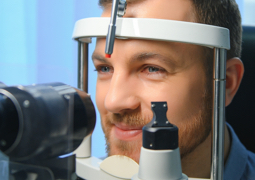
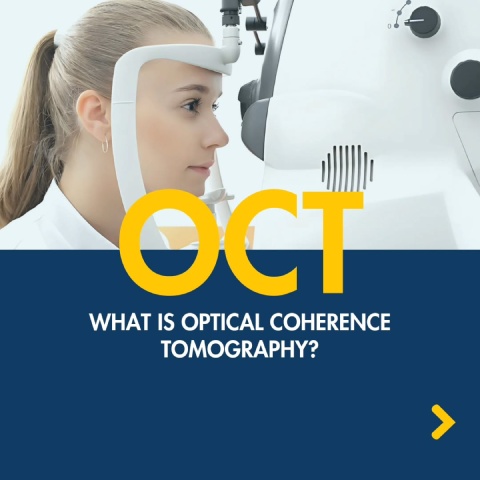
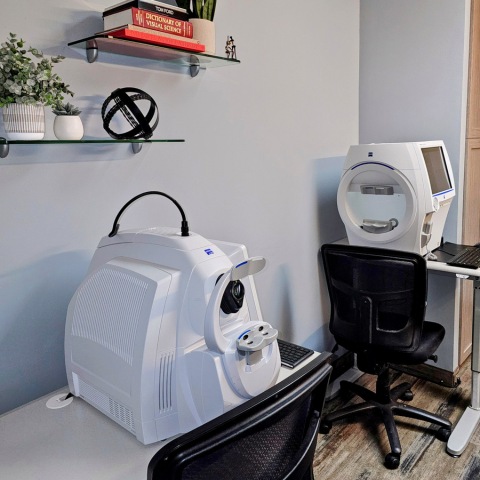
Early dry AMD typically has no symptoms you’d notice on your own. You won’t feel it, and your vision might seem fine. That’s what makes routine eye exams so valuable. Calgary Family Eye Doctors uses diagnostic imaging to look at the layers of the retina and spot changes before they affect what you see day to day. Tools like optical coherence tomography (OCT) give your eye doctor a detailed view of the retina that simply isn’t possible with a standard vision check.
Earlier detection means more options. When AMD is found in its early stages, there’s more room to make changes and monitor what’s happening. Waiting until something feels wrong often means the window for the most useful interventions has already narrowed.
Come See Us
If you’re 50 or older, have a family history of AMD, or just want to stay on top of your eye health, Calgary Family Eye Doctors welcomes patients from Southwood, Willow Park, Acadia, Canyon Meadows, and surrounding South Calgary communities. Book your eye exam and get a clear picture of where your vision stands today.