

Key Takeaways
- Astigmatism is a common vision condition caused by an irregularly shaped cornea or lens.
- Blurry vision, headaches, and difficulty seeing at night are all typical signs in adults.
- Children often don’t notice the problem, which is why regular eye exams matter.
- Glasses, contact lenses, and other options can correct most cases.
- A comprehensive eye exam is all it takes to detect it.
Astigmatism Affects How Your Eyes Focus Light
If you’ve ever had trouble reading a road sign at night, or if you’ve noticed that your vision is slightly off no matter how hard you squint, it’s possible that you have astigmatism.
Astigmatism isn’t a disease. Rather, it’s a condition where the cornea or lens of the eye has an irregular shape. This causes light to focus unevenly on the back of the eye, causing vision to become blurry at any distance. The good news is that astigmatism is easily detected and can be managed effectively.
If you’re struggling with your vision, our team at Calgary Family Eye Doctors is here to help.
What Astigmatism Actually Is
A healthy cornea is smooth and evenly curved. In people with astigmatism, however, the cornea or lens of the eye is shaped irregularly. This uneven surface causes light to focus incorrectly, resulting in vision that looks blurry, stretched, or doubled at all distances.
Astigmatism is very common. Many people have a mild degree of it and never know until an eye doctor checks. However, other people find that astigmatism affects their day-to-day comfort and clarity.
Signs and Symptoms to Watch For
Common Symptoms in Adults
Common signs of astigmatism include:
- Blurred or distorted vision at any distance.
- Frequent headaches or eye discomfort, especially after reading or screen time.
- Difficulty seeing clearly in low light or at night.
If any of these persist or worsen, it’s worth getting your eyes checked by your optometrist.
What It Looks Like in Kids
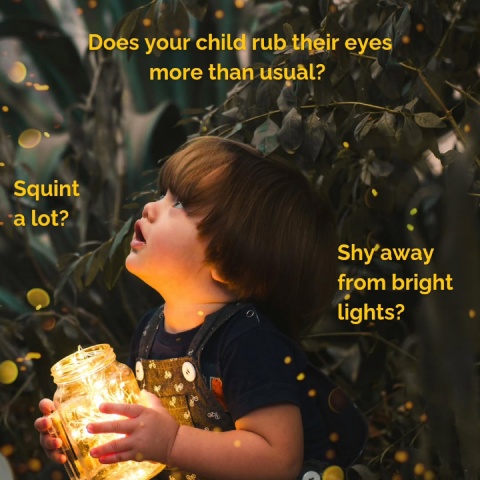
Children don’t have a clear reference for what “normal” vision looks like, so they rarely complain about blurry sight. What you might notice instead are behaviors like squinting, holding screens close to their eyes, and struggling to keep up at school.
That’s why routine eye exams for kids matter so much. Catching astigmatism early means that it won’t interfere with their reading, learning, or classroom performance.

What Causes Astigmatism
Most Common Reasons
Astigmatism is often present from birth, and it can run in families. It can also develop after an eye injury or surgery that changes the shape of the cornea.
Astigmatism & Related Conditions
In some cases, astigmatism is associated with a condition called keratoconus, where the cornea gradually thins and begins to bulge outward. This is much less common, but it’s worth being aware of.
Astigmatism also frequently appears alongside nearsightedness and farsightedness, though astigmatism has slightly different causes.
Correction Options for Astigmatism
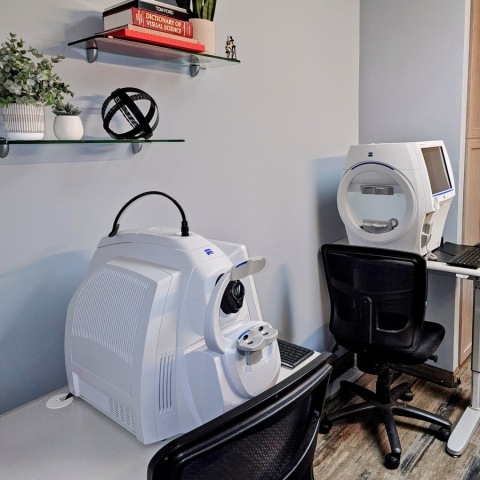
Astigmatism can be detected during a routine comprehensive eye exam. This is the same appointment where your optometrist checks for myopia, farsightedness, and overall eye health. If you do have astigmatism, there are several straightforward options for correction.
Common Options
Most cases of astigmatism can be corrected with glasses or contact lenses, including toric lenses, which are designed specifically for eyes with an irregular shape. If your astigmatism is mild, correction may not be necessary right away. Your optometrist will help you figure out what makes sense for your vision and your lifestyle. When you’re ready to explore frames, our frames and lenses options cover a wide range of prescriptions and styles.
Other Options Worth Knowing
Beyond glasses and contacts, there are a couple of other options for correction:
- Orthokeratology, or ortho-k, uses specially fitted lenses to reshape the cornea while you sleep. This allows you to see clearly during the day without lenses.
- Laser surgery reshapes the cornea to correct astigmatism on a longer-term basis. If this option interests you, a laser eye surgery consultation can help clarify whether you’re a good candidate.
Not every option fits every person. As your eye doctor in Calgary, we can walk you through what works for your prescription, your habits, and your eyes.
Talk to Calgary Family Eye Doctors
Astigmatism is common, manageable, and detectable with a routine eye exam. Whether you’re booking for yourself or for your child, Calgary Family Eye Doctors serves families across South Calgary, including Southwood, Willow Park, Acadia, Canyon Meadows, and Maple Ridge. Book an appointment and get a clear picture of where your vision stands.